
New Report Offers Blueprint to States in Response to Federal Climate Rollbacks
WASHINGTON, D.C. —September 18, 2025—Today marks the launch of the Public Renewables Project, a new climate advocacy organization dedicated to bringing publicly financed, publicly developed renewable energy to communities across the country. The Public Renewables Project’s mission is to stand up public renewable energy developers in all 50 states, to build the clean power that for-profit developers are not delivering.
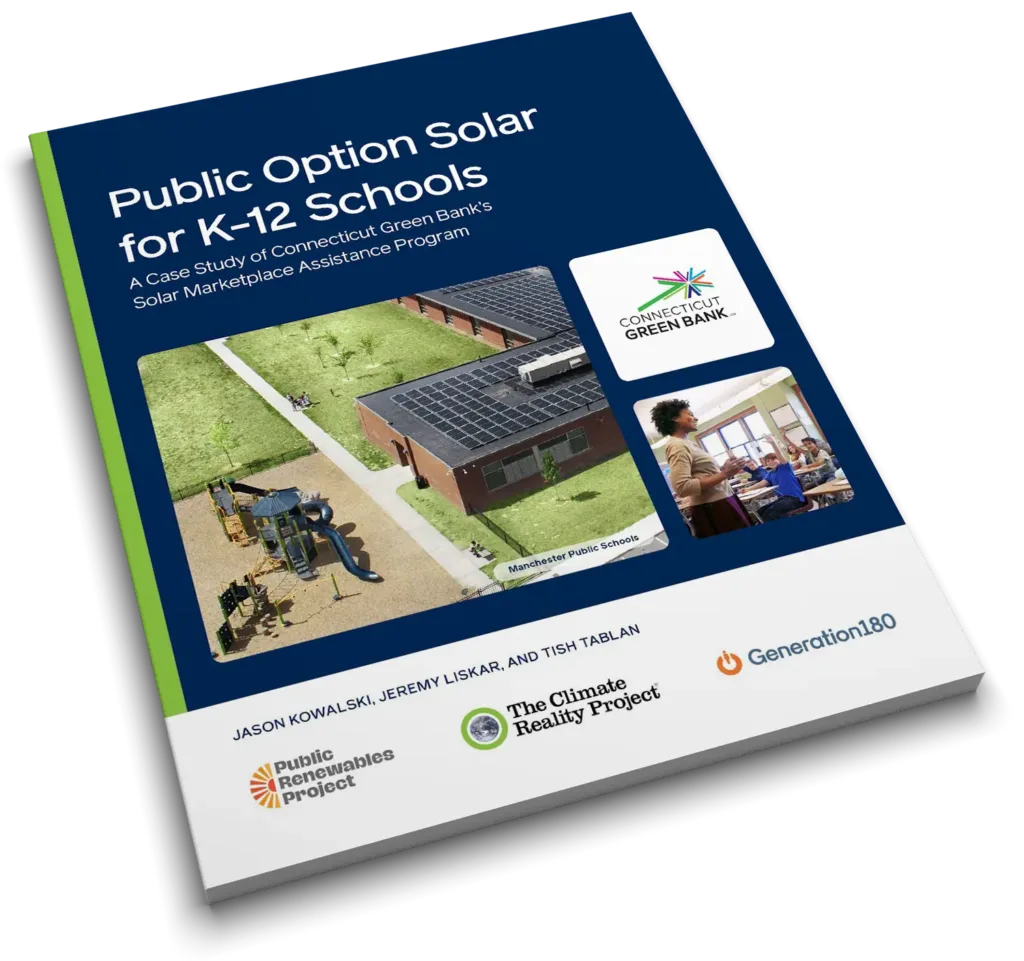
Public Renewables Project debuts alongside the release of a major report: Public Option Solar for K-12 Schools. The report documents how the Connecticut Green Bank successfully built a “public option” solar model that has made Connecticut #1 in the contiguous U.S. for solar schools. From 2015–2023, Connecticut’s publicly developed projects accounted for 27% of the state’s K-12 solar projects, with 50-75% targeted to low-income disadvantaged communities in recent years.
“Public renewables offer a practical response to federal climate rollbacks,” said Jason Kowalski, report lead author and Founder and Executive Director of the Public Renewables Project. “States need new ways to move forward. Connecticut proves that the public developer model works, and all 50 states already have the public finance tools to follow their lead. Our goal is to replicate this success nationwide.”
“As somebody who worked in multiple levels of government and seen the impact of clean energy investment in local communities, it’s clear that public renewables are a perfect way to accomplish the goals of creating good, high paying union jobs, and committing ourselves to long-term energy sustainability,” said Gerardo Bonilla Chavez, Senior Advisor to the Public Renewables Project, and former Chief of Staff to Congresswoman Alexandria Ocasio-Cortez.
Other Strategists and Advisors Include:
- Ben Beachy, formerly White House Climate Policy Office
- Hebah Kassem, formerly Sierra Club
- Isabel Estevez, formerly Roosevelt Institute
To learn more about the team and the Public Renewables Project, visit www.publicrenewables.org. For interviews requests, contact Jacqueline Lara at jacquelinel@mpactpr.com.
-30-
About Public Renewables Project
The Public Renewables Project is a new climate advocacy organization calling for publicly financed, publicly developed renewable energy. Our mission is to stand up public renewable energy developers in all 50 states to build the clean power that for-profit developers are not delivering. We partner with labor unions, climate groups, grassroots organizations, and public finance experts to deploy public renewables in a way that lowers costs, reduces inequality, and increases worker power. Learn more at www.publicrenewables.org
About Jason Kowalski:
Jason Kowalski is the Founder and Executive Director of the Public Renewables Project. Jason has 15 years of experience bridging social movements and legislative politics to achieve ambitious climate and economic policy victories. He is recognized for developing innovative solutions, including publicly owned renewable energy, democratic public finance institutions, and worker-centered climate policy. Jason’s work challenges the fossil fuel industry’s power while equitably decarbonizing the economy.
How Connecticut’s Public Developer Model Works:
Public finance institutions, like green banks and state development finance agencies, can finance and own K-12 solar projects, and then sell the power back to schools at lower rates than the utility charges. Schools can save money from day one, with no upfront costs or added staff time. Because every state has at least one of these institutions, this full-service public-public partnership can be replicated nationwide.
Behind the scenes, this approach is powered by innovative public finance tools. Institutions like the Connecticut Green Bank can recycle capital again and again, leveraging the value of one round of investments to access additional capital (often through bonds) and finance future rounds of clean energy projects. This public developer model turns green banks into self-sustaining engines of decarbonization that keep building projects no matter who is in power in Washington, DC.